Before a Kawana Waters jet ski gets anywhere near the Mooloolah River, it has to pass the Parrearra lock. That lock is the only way a vessel gets from the Kawana lake system to the river. It takes registered motorised vessels only, and you need a card or FOB from a council customer contact centre to use it.
The licence comes first. You'll do it at our Caloundra venue in the Golden Beach locality, on the Pumicestone Passage. The theory's online, then the day has a recap, the theory assessment and your one-on-one ride on a ski we supply.
Riding out of Kawana Waters is a bit like leaving a gated estate. There's a gate, a pass for the gate, a slow road on the other side, and then a harbour mouth with its own rules. None of it is hard once you know the order. Here it is, from the lake to the sea.
Step one is the lock at Parrearra. Council's Parrearra Lake Management Plan 2019-2029 says it lets registered motorised vessels pass through safely at low tide, up to 15 metres long, 4.5 metres wide and 2.0 metres draft. A registered jet ski sits comfortably inside those limits. Paddle craft are the ones turned away. Kayaks, stand up paddleboards and canoes can't use the lock, and they're carried over two sets of steps built into the weir instead. So on this water, the licensed rider on a registered ski is the one who gets the easy route.
The catch is paperwork. You can't just roll up. Access needs a card or FOB, collected in person from a council customer contact centre, and you need photo ID to get it. It's a separate errand from your licence. Do it before the first weekend you want to ride.
Why is there a lock at all? The lake doesn't move with the tide the way the river does. Parrearra Lake has a restricted tidal range of about 300 millimetres. The lock bridges the gap between the two water levels. If you'd rather skip it on a given day, the nearest all-tide trailer ramp is Outrigger Park at Minyama.
Step two is the canals on the other side. All canals connected to the Mooloolah River between the entrance near Mooloolah Drive and the entrance near Chelsea Crescent carry a 4-knot limit, gazetted in 2004. It's the only 4-knot zone in the area. Everywhere else nearby that's restricted is 6 or 20 knots. Four knots on a ski is walking pace with the engine ticking over, and it takes more control than people think.
Step three is the river and the harbour. The Mooloolah is 6 knots for all waters downstream of McKenzies Bridge, and that includes the Mooloolaba Boat Harbour. So the stretch between the canals and the sea is slow too.
Then there's the bar. The Mooloolah is the only one of the four Sunshine Coast bars with engineered training walls. It's also the only one with a published maintained depth: MSQ aims to keep the harbour entrance clear to at least 2.5 metres below lowest astronomical tide, with ongoing dredging. That's more reliable than most. It isn't a promise. Shoaling has got worse, and big events in 2011-12 and 2022 needed continuous dredging for long stretches. MSQ runs live cameras on the two breakwater towers, taking a photo every 15 minutes, so you can check the entrance before you leave. If you do cross, it's a designated bar, so the lifejacket must be worn, and on a ski you're always in the open.
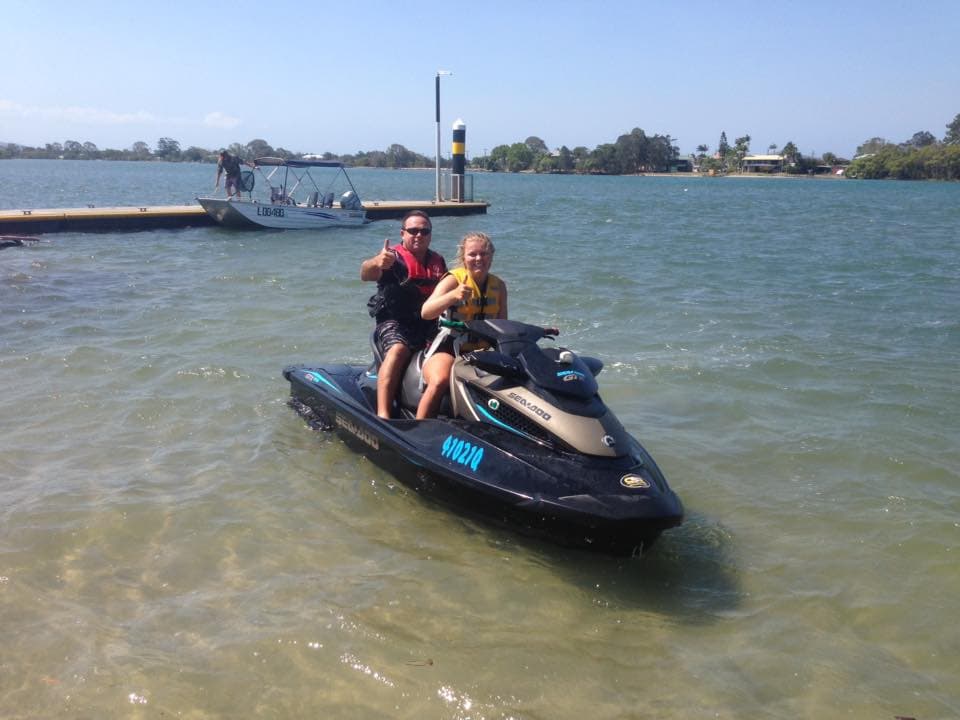
Now the honest part. We don't train on the Mooloolah. The course runs from our Caloundra venue on the Pumicestone Passage, a shallow, tidal waterway where about 80% of the water is under two metres. What carries over is the handling. You'll ride a Sea-Doo with braking, reversing and a learner mode, and it's very stable, which helps with the docking and figure 8 manoeuvres in your assessment. At Caloundra the jet ski practical is published as roughly 45 minutes, one-on-one. Slow, tidy control is exactly what a 4-knot canal and a lock chamber ask of you.
If you don't hold a boat licence yet, book the Boat and Jet Ski Combo. Riding a ski legally takes both a recreational marine licence and a PWC licence. Already licensed for boats? The jet ski course on its own covers the rest.
The course itself is the same wherever you sit it: the theory online first, in your own time, then a day on the water with a trainer before the assessment. You need a licence for any boat with an engine over 4.5 kilowatts, which is nearly every tinny, runabout and cruiser. Pass, and the Queensland licence never expires. Pick the date that suits you and book online.