At Twin Waters, getting the ski on the river means a trailer and a ramp. The resort lake is a constructed coastal lake with no lock into the river, and the council register shows no public boat ramp on it. The suburb's two boat ramps, the State-owned one at Nojoor Road and the council one at Anchorage Circuit, both open onto the Maroochy River. That's also the river your course runs on, from our Maroochydore venue. Do the theory online first. Then come in for a theory recap, the assessment and a one-on-one practical on the ski. We supply the jet ski, the lifejackets and all the gear.
Plenty of new ski owners here picture the first ride starting at the back fence. It starts at a ramp instead. The stretch of water just after the ski floats off the trailer is where a new Twin Waters rider is most likely to break a rule without noticing. Ramps, pontoons, people wading and the riverbank each come with jet ski speed limits of their own. So this page follows the ride in the order it happens, from the lake out to the river.
The lake first. Council lists Twin Waters among its constructed coastal lakes, and it names navigational locks only at Parrearra Lake and Pelican Waters North. With no lock, a ski on the Twin Waters lake has no way through to the Maroochy. Whether a ski may be ridden on the lake at all isn't something any public register tells us, so we won't guess. If the river is where you want to ride, plan on a trailer.
Next, the ramp. The council register holds seven water access records for Twin Waters, and two of them are boat ramps. One is State-owned, on the Maroochy River Esplanade at Nojoor Road. The other belongs to council and sits at Anchorage Circuit. Both are on the Maroochy. The register records nothing about parking or tide status for either one, so go and look before your first launch.
This is where the jet ski rules kick in. Section 82 of the Transport Operations (Marine Safety) Regulation 2016 says a personal watercraft must not go faster than 6 knots within 60 metres of any of these: a person in the water; a ship at anchor, moored, made fast to the shore or aground; a jetty, wharf, boat ramp or pontoon; the boundary of a bathing reserve; or the shore. So the ramp you just left keeps you at 6 knots until you're 60 metres clear of it. The bank does the same, and so does anyone wading nearby.
The shore part of that rule has three exceptions. It doesn't apply while the ski is being used for waterskiing, which the regulation defines as towing a person by a line, and that includes someone on a toboggan or tube. It doesn't apply where the water is less than 120 metres wide and you keep to the centre or a marked channel and go straight through. And it doesn't apply where sticking to it would put someone in danger. Towing anyone at all needs your own licence, by the way. A licensed supervisor on board doesn't cover it. The maximum penalty under section 82 is 200 penalty units.
Out on the river, two more ski rules ride with you. The same section caps a ski at 10 knots within 30 metres of another moving ship. Then there's section 86. In coastal waters, and tidal waters count, a ski must not freestyle, surf or wave jump within 200 metres of the shore if one or more homes stand within 100 metres of the shore and can be seen from the ski. The lower Maroochy is tidal water: MSQ measures its depth near the mouth against lowest astronomical tide. Passing a riverside suburb is exactly the moment to check for houses before you jump any wash.
All of that sits on top of the posted limits. MSQ runs a marine safety system for the Maroochy, with speed signs and hazard signs along the river. The ski rules above go wherever the ski goes. The signs fill in the rest.
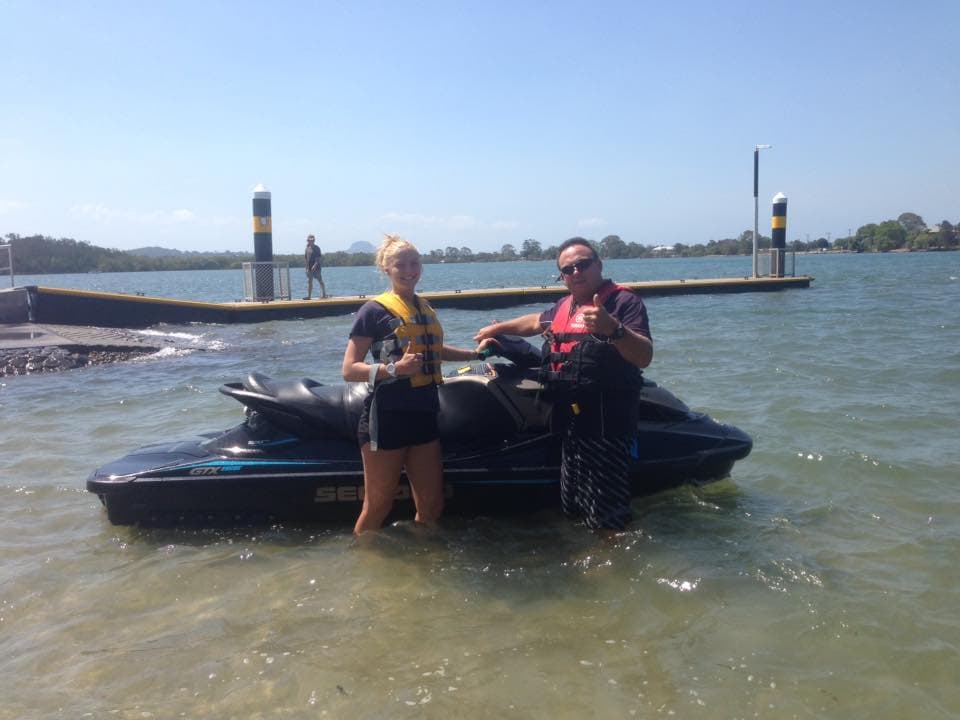
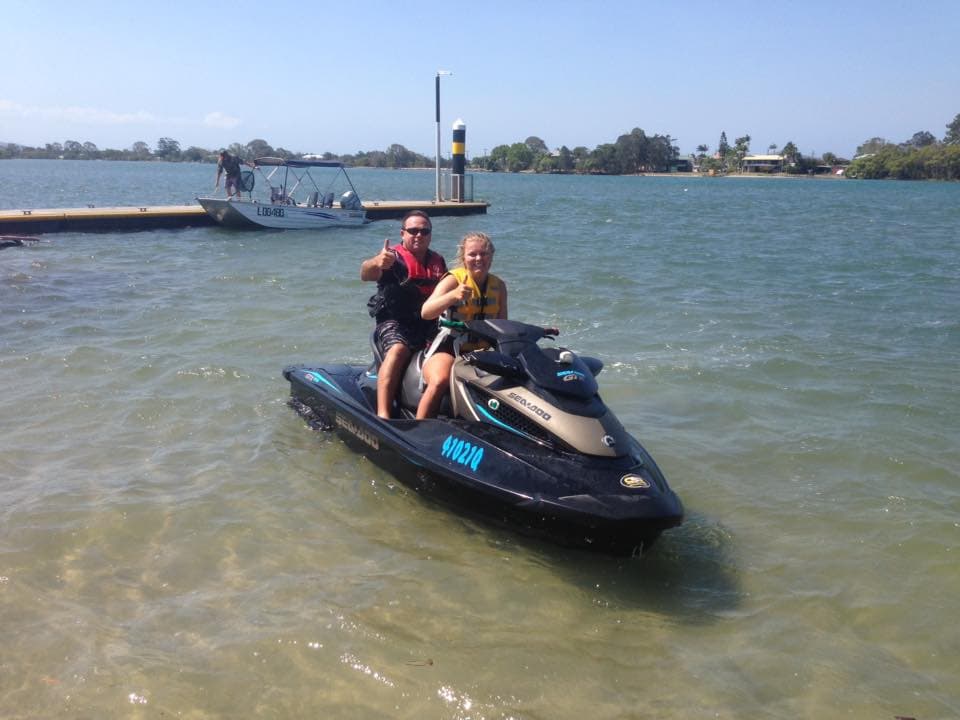
Now the course. It runs from our Maroochydore venue, on the same river as your ramps, and there's no course venue in Twin Waters itself. A jet ski is a personal watercraft, and riding one legally takes both a recreational marine licence and a PWC licence. Already hold a current boat licence? You can do the jet ski course on its own. If not, book the Boat and Jet Ski Combo. You'll ride a Seadoo. Its braking, reversing and learner mode suit a first-timer as well as someone who's ridden before, and its stability helps with the docking and figure 8. You need to be 16 to hold the licence, and it's valid for life once issued.
The course itself is the same wherever you sit it: the theory online first, in your own time, then a day on the water with a trainer before the assessment. You need a licence for any boat with an engine over 4.5 kilowatts, which is nearly every tinny, runabout and cruiser. Pass, and the Queensland licence never expires. Pick the date that suits you and book online.