• Sunshine Coast & Caloundra

Personal Flotation Devices

Wear a lifejacket. It could save your life.

Personal Floatation Device

Below is a summarized small list of real experiences which have occurred to offshore boaties. We’ve placed them here so you can think about how you’d handle them in the comfort of your lounge room, rather than facing the situation on the water.

These things have happened, as well as a few thousand others not mentioned! (We’ve left out the good things about boating, you’ll discover them yourself).
Please consider these safety suggestions:

  • It’s little use to you if you’re not wearing it
  • Anybody venturing out in any type of craft
    • canoe/windsurfer etc should wear one
  • Everybody onboard needs to wear an approved PFD when crossing a coastal bar
  • Always wear one if boating alone (put a Personal Locating Beacon in your pocket as well, in case you fall overboard and the boat keeps going)
  • Always wear one at night
  • Always have a suitable jacket on young children. Very young children don’t float and sink immediately
  • PFDs must meet the current Australian Standard
  • PFDs must fit the intended wearer – eg if kids are on board, the vessel must be equipped with kid’s PFDs
  • PFDs will always have a label identifying the type, body mass flotation, and Australian Standard
  • If the label is illegible, the PFD is not suitable
  • PFD 1s, always have reflective tape, and also a whistle, which doubles as a sound signal device
  • Don’t wear a PFD 1 when water skiing, as their neck support might cause neck damage in a fall
  • Comfortable yoke-style PFD 1s are now available which use a CO² cartridge to inflate. These must be serviced as per manufacturer recommendations
  • Don’t leave the PFD in the plastic wrapper you bought them in. Have them readily accessible and ready for use in case of an emergency
  • Instruct all persons coming on your boat where the PFDs are, and how to put one on
  • Don’t use the pillow style PFDs as a seat cushion, as this reduces the life span of the stitching
    Please consider these safety suggestions:

    The Water Police check life jacket conditions when they do vessel checks. If they find split seams, faded labels, etc, you will be warned/fined
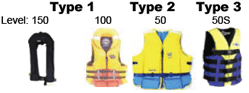
    A new flotation device determining system is coming in 2010, to replace the Type 1,2,3 codes. The new system, and the equivalent codes are:
Level 150 (equivalent to inflatable PFD1)
Level 100 (equivalent to PFD1)
Level 50 (equivalent to PFD 2)
Level 50S (equivalent to PFD 3)

PFD 1,2,3 type jackets will remain approved for many years, so no need to replace them now.

Personal Floatation Device

Below is a summarized small list of real experiences which have occurred to offshore boaties. We’ve placed them here so you can think about how you’d handle them in the comfort of your lounge room, rather than facing the situation on the water.

These things have happened, as well as a few thousand others not mentioned! (We’ve left out the good things about boating, you’ll discover them yourself).

Personal Floatation Device

Below is a summarized small list of real experiences which have occurred to offshore boaties. We’ve placed them here so you can think about how you’d handle them in the comfort of your lounge room, rather than facing the situation on the water.

These things have happened, as well as a few thousand others not mentioned! (We’ve left out the good things about boating, you’ll discover them yourself).

Please consider these safety suggestions:

The Water Police check life jacket conditions when they do vessel checks. If they find split seams, faded labels, etc, you will be warned/fined
A new flotation device determining system is coming in 2010, to replace the Type 1,2,3 codes. The new system, and the equivalent codes are:
Level 150 (equivalent to inflatable PFD1)
Level 100 (equivalent to PFD1)
Level 50 (equivalent to PFD 2)
Level 50S (equivalent to PFD 3)

PFD 1,2,3 type jackets will remain approved for many years, so no need to replace them now.

Boating Terminology

Below is a list of commonly used boating and nautical terms. If you are a boat owner or are looking to purchase a boat, it is important to know the correct boating terminology to ensure you stay safe while on the water.

Sacrificial Anode - Metal parts fitted to the hull of a vessel to provide a transfer of ions to t he cathodic part of an electrolytic coupling and so protect other parts of the vessel that would otherwise waste away through electrolysis
Schooner - A sailing vessel fitted with two or more masts carrying fore and aft sails. When it is fitted with two masts, the forward may be shorter than the other
Scuppers - Drains from decks to carry off rain or sea water
Shank - In an anchor, the straight section between the chain attachment and the flukes
Shoal Water - Shallow water
Sloop - A sailboat with a single mast and fore and aft rig, usually with a single jib and mainsail
Spring Line - A mooring rope oriented at a small angle to the vessels centre line
Starboard Side - The right hand side of a vessel when looking forward
Stays - Fixed wire ropes leading forward from aloft on a mast to the deck to prevent the mast from bending aft. Backstays lead from aloft to aft
Stern - After end of a vessel
Stow - To put away. To stow cargo in a hold
Tiller - An arm, attached to rudder stock, which turn the rudder
Transom - The stern cross section of a square sterned boat
Windlass - The machine used to hoist and lower anchors
Yawing - Weaving motion of a vessel to port and starboard off course
This is a basic text element.

We often send out our newsletter with news and great offers. We will never disclose your data to third parties and you can unsubscribe from the newsletter at any time.

Unfortunately, we’re unable to offer free samples. As a retailer, we buy all magazines from their publishers at the regular trade price. However, you could contact the magazine’s publisher directly to ask if they can send you a free copy.

You can create a new account at the end of the order process or on the following page. You can view all of your orders and subscriptions in your customer account. You can also change your addresses and your password.

No, you don’t have to create an account. But there are a few advantages if you create an account.

  • You never have to enter your billing and shipping address again

  • Find all of your orders, subscriptions and addresses in your account

  • Download invoices of your orders

No, we don’t have a physical store location at the moment. We accept only orders through our online shop and we’re shipping all orders with the Swiss Post Service. Please visit our shipping section for more details.

From time to time you will find us at design fairs and popup markets in Switzerland. Subscribe to our newsletter and you’ll receive the latest news.
Tab Content

This is a basic text element.

Tab Content

This is a basic text element.

Tab Content

This is a basic text element.

Tab Content

This is a basic text element.

Tab Content

This is a basic text element.

Service Locations

We are your local provider for Boat and PWC servicing on the Sunshine Coast for over 20 years.

Our courses and training methods are designed to ensure your experience with us is informative and fun.

© 2025 Sunshine Coast Boat Licence. Website design and hosting by Smart Local. RTO3399